How to Work in Saudi Arabia — Work Visa Process Step by Step (Pakistan & India)
The legal route to a Saudi Arabia job runs in a fixed order: an approved BE&OE demand, application and selection, a GAMCA / Wafid medical, a signed Foreign Service Agreement, the work visa, the Protector of Emigrants stamp, and then your flight. Each step leaves a paper trail in your name. If anyone offers you a shortcut outside this order — above all a "visit visa job" — that shortcut is where the fraud happens.
Thousands of Pakistanis go to Saudi Arabia for work every year through a legal, well-defined process. This page explains how to work in Saudi Arabia the legal way, from an approved demand to the day you fly. If anyone offers you a shortcut outside this process, that shortcut is where the fraud happens. Here is the real route, step by step.
Step 1, An approved demand
A Saudi employer asks for workers. In Pakistan, a licensed Overseas Employment Promoter (OEP) gets that demand approved by the Bureau of Emigration & Overseas Employment (BE&OE). Only after approval, with a permission number, may the agency advertise and select workers. This is why you should always ask for the licence number and permission number first (see our licence verification guide).
Understand what the approval actually covers, because it protects you later. The permission is not a general blessing on the agency. It ties one named Saudi employer to one country and one trade, and it is the paper that says the government has seen this demand before a single worker was collected for it. When an agency advertises first and talks about approval later, the order is already wrong — and in this process, order is nearly everything. Every later step, from your medical to your Protector stamp, builds on this first piece of paper. If it is missing, everything built on top of it is missing too.
A practical point: the advertisement itself is part of the record. Keep the newspaper cutting or a screenshot of the listing you applied against. The salary, the trade and the benefits printed there are what the agency offered publicly, and they are what you compare the agreement against at Step 4.
Step 2, Application and selection
You contact the agency, show your passport, CNIC and any experience certificates, and attend an interview or trade test if the employer requires one. For technical trades (welder, electrician, steel fixer and similar), a practical test is normal. Selection is confirmed by the agency in writing. Keep every paper ready before you apply — use our complete documents checklist.
The selection stage is where honest agencies and dishonest ones start to behave differently, and it costs you nothing to watch for it. An honest agency looks at your documents, asks about your experience, and for a trade job makes you show the work — a welder welds a test piece, a driver drives, an electrician wires a board. The test feels like an exam because it is one: the Saudi employer will judge the agency by the men it sends, so the agency judges you first.
Selection is confirmed in writing. Guard that paper. It should name you, the trade you were selected for, and the demand you were selected against. If an agency tells you that you are selected but gives you nothing in writing, ask for it before the process moves one step further. A verbal selection followed by a demand for money is one of the oldest shapes of fraud in this business: the money is real, the selection is not.
Your documents need care at this stage too. Show originals when asked, but keep track of every original that leaves your hand, and know why it was taken. A passport handed over for visa processing at the proper stage is normal; a passport collected by an unlicensed man "to start your file" is not. And if writing a CV is where you get stuck, our CV making service prepares one for you — a clean CV matters more for office, technical and driving jobs than most workers expect.
Step 3, Medical examination
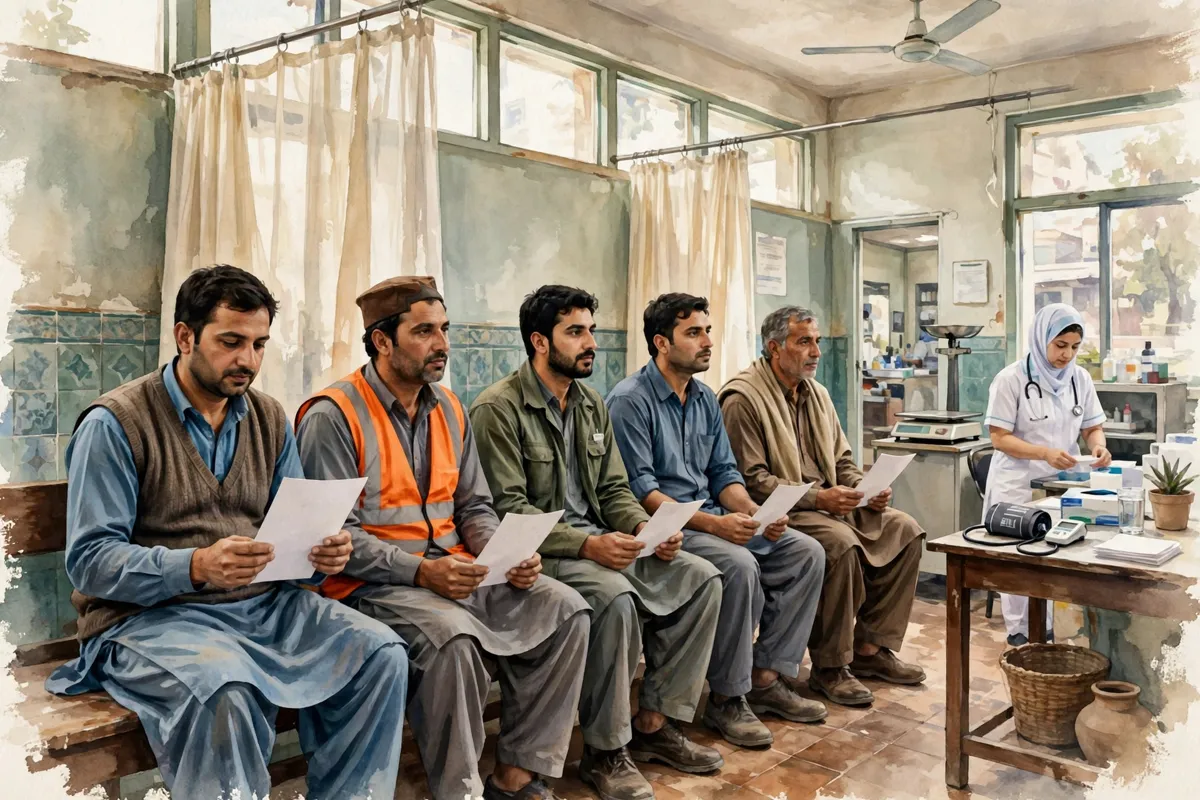
Selected candidates complete a medical examination at a GAMCA / Wafid-approved medical centre. The medical is booked through the official system, you receive a slip with your details. Fitness requirements cover general health, eyesight, and infectious diseases. If you are declared unfit, the process stops there; no agent can "fix" an unfit medical legally.
The slip is the part to understand. It is generated through the official booking system and carries your own details, and it ties your medical to you and to this journey — not to the agency's drawer. Go for the examination yourself, in person. A medical done by sending your photograph and money through a middleman is not a medical at all, and a "fit" report bought that way can collapse the first time a real system looks at it, which may be at the worst possible moment.
Notice the order again: the medical comes after selection, never before it. An operator who wants medical money from every hopeful who walks in — before any interview, any test, any selection — is collecting fees from fifty men for a demand that may hold five. That is not the process; that is a business built on your hope. In the real process, unselected men are not sent for medicals, because the slip system exists to examine candidates, not crowds.
Step 4, Foreign Service Agreement (FSA)
You and the agency sign a Foreign Service Agreement that states your job, salary and conditions. Read the salary figure carefully and keep your copy. The salary in the FSA is the salary you should receive in Saudi Arabia; if the agent verbally promised more, the written FSA is what counts. Not sure what the salary figure means at home? See Gulf salaries in rupees, explained.
What should I read in the Foreign Service Agreement before signing?
Read it the way the other side will read it later — as the only version of the promise that exists. Go through it line by line, or sit with someone you trust and have it read to you, and check these things against the advertisement you saved at Step 1.
- The job title. It should be the trade you were selected and tested for. A steel fixer who signs an agreement that says "general labour" has signed a different job, with different pay, and the signature is his.
- The salary figure. Compare it digit by digit with the advertisement and with what was promised to your face. If the figure in the agreement is lower, the time to object is before the pen touches the paper, not after you land.
- The benefits. Food, accommodation, transport and medical cover from the employer are part of most genuine demands. If the advertisement offered them and the agreement is silent about them, ask why, and get the answer in writing.
- Overtime. Many listings mention duty hours plus overtime. Only overtime written into the agreement is part of your salary. A spoken promise of heavy overtime is weather talk — pleasant, and worth nothing in a dispute.
- Your copy. You leave with a signed copy. Not a photograph of one page, not a promise that the copy will follow — the copy, in your file, the same day.
Never sign a blank agreement, and never sign one in a hurry because a queue is waiting behind you. The agreement is the one document that will speak for you when you are 3,000 kilometres from the man who made the promises. Give it the ten quiet minutes it deserves.
Step 5, Visa and Protector stamp
The agency processes your work visa (now usually an e-visa) through the Saudi system. Then, before departure, your passport must carry the Protector of Emigrants stamp from your district's Protector office. The protector stamp is Pakistan's official record that you are leaving for legal overseas employment, never travel for work without it. It also connects you to insurance and welfare protection for overseas Pakistanis.
The stamp deserves a paragraph of its own, because men treat it as a formality and it is not one. When the Protector office stamps your passport, the state records that you — this named worker, with this passport — are leaving against a legal demand, through a licensed promoter, for a named employer. That record is what stands behind you if something goes wrong abroad: it is the thread that connects you to the insurance and welfare protection arranged for overseas Pakistanis, and it is how your family can trace where you went and through whom. A worker who slips out without it has cut that thread himself.
At the airport, this is also practical. A man travelling out on a work visa without the Protector stamp can be stopped before he ever boards, and every rupee of his preparation stops with him. Get the stamp after the visa and before the flight, from your own district's Protector office, and check with your own eyes that it is in the passport before you leave that office.

Step 6, Ticket and travel
Many approved demands include a free ticket provided by the employer; where it does not, the FSA and advertisement should say so clearly. Travel only on the date the agency confirms, and keep the agency's Saudi contact details with you.
On the day itself, travel like a man carrying his whole case in one bag: passport with the stamp, your copy of the agreement, the agency's contact details in Saudi Arabia, and a phone number at home that will be answered. Leave a full copy of everything with your family before you go — the agreement, the visa, the ticket, the agency's licence details. If anything is ever questioned later, the copy at home is the family's voice in the matter. Then go, and go on the confirmed date: a missed flight on an approved demand creates the kind of confusion in which workers get separated from their own paperwork.

One worker's journey, from newspaper ad to departure gate
Put the steps together and they look like this. A steel fixer — call him Rashid, though every town has fifty men living this same story — sees a newspaper advertisement for Saudi Arabia. Before he visits the agency, he checks the licence and the permission number on beoe.gov.pk, the way the licence verification guide describes, and both pass. He clips the advertisement and puts it in a file.
At the agency he is interviewed and given a practical test, and his selection comes back in writing. Only then is his medical booked, through the official slip, at an approved centre — and he goes himself. The Foreign Service Agreement is placed in front of him; he reads the salary figure against the figure in his clipped advertisement, sees they match, signs, and takes his copy home the same day. The agency processes the visa. With the visa in hand he goes to his district Protector office and watches the stamp go into his passport. The ticket arrives against the same demand, with a date. On that date he flies, with copies of everything in his bag and the originals of his file sitting at home with his brother. Nothing in Rashid's story is dramatic. That is the point. The legal process is boring on purpose — each step leaves a mark, and the marks are what protect him.
How much should this process cost — and what is not legal?
Agencies may charge a regulated service fee, but you must always receive a proper printed receipt showing the agency's name and licence number. Never pay cash without a receipt, and never pay anyone, agent, sub-agent or "middleman", who cannot show a licence. Most genuine Gulf demands also include free food, accommodation, transport and medical cover from the employer; check the benefits line of any listing before you compare salaries.
The receipt is worth understanding properly. A proper receipt is not scrap paper with a figure on it. It carries the agency's name and licence number and the amount, and it connects your payment to the licensed business — which means the business can be held to it. Cash handed to a sub-agent in a teashop, against a signature on a diary page, connects your money to nothing. If a dispute ever opens, the first question asked will be: where is your receipt, and whose name is on it? Arrange your affairs so that question has a good answer.
Ready to start? Browse today's verified jobs in Saudi Arabia — most current demand is in Riyadh, Jeddah and Dammam, and every listing shows its licence and permission numbers.
What are the most common mistakes in this process?
- Paying before selection. In the legal order, selection comes before money changes hands for processing. Fees demanded from every applicant at the door are a collection scheme, not a process.
- Doing the medical before selection. The medical belongs after selection, booked on an official slip in your name. A "medical" sold to unselected men proves nothing and protects no one.
- Signing the agreement without reading the salary. The written figure is the salary. If it differs from the promise, the signature makes the written one yours.
- Handing originals to an unlicensed man. Your passport should move through the licensed agency's hands at the proper stages, against receipts — not sit in a stranger's drawer as "security".
- Skipping the Protector stamp. It is the state's record of your legal departure and your link to insurance and welfare protection. Travelling for work without it can stop you at the airport and leaves you untracked abroad.
- Believing in the visit visa conversion. It does not exist as a legal route, and the men selling it know that better than you do.
The India route, in short
Indian workers follow the same shape through the eMigrate system: a registered Recruiting Agent receives the Saudi employer's demand, selection and medical follow, and the work entry permit is processed by the employer in Saudi Arabia. If your passport is ECR category, you need emigration clearance from the Protector of Emigrants before departure (see our licence verification guide). ECNR passport holders are exempt from the clearance, and the Pravasi Bharatiya Bima Yojana insurance is compulsory for ECR emigrants. The dangers are identical too: no registration, no receipt, or a "visit visa job" offer means walk away.
The shape deserves one more sentence, because Indian workers are often told their system is entirely different. It is not. Different office names, same skeleton: a registered agent, an approved demand behind the job, selection before money, a medical in its proper place, a written agreement, and a government clearance standing between the worker and the departure gate. Learn the shape once and you can judge any offer, in either country, in a few minutes.
Two statements from this page are worth carrying in your head. In Pakistan, no recruiter may legally advertise a Saudi job before BE&OE has approved the demand and issued its permission number. And the Protector of Emigrants stamp is the official record that a Pakistani worker is leaving for legal overseas employment — the same record that links him to insurance and welfare protection.
Every Saudi job listed by InGulfJobs follows the route on this page and prints its licence and permission numbers on the listing. If you want to see the checking we do before a job is allowed onto the site, read how InGulfJobs verifies every job.
Remember: there is no legal "visit visa job" in Saudi Arabia. If someone offers to send you on a visit visa and "convert it later", refuse, working on a visit visa can get you jailed, fined and deported.
Key points
- The legal order never changes: approved demand, selection, medical, Foreign Service Agreement, visa, Protector stamp, flight.
- An OEP may only advertise and select workers after BE&OE approves the demand and issues a permission number.
- The medical is done after selection, at a GAMCA / Wafid-approved centre, on an official slip in your name.
- The salary written in your Foreign Service Agreement is the salary that counts — check it against the advertisement before you sign, and keep your copy.
- Never pay cash without a printed receipt showing the agency's name and licence number.
- Never travel for work without the Protector of Emigrants stamp in your passport.
- There is no legal "visit visa job" in Saudi Arabia — working on a visit visa can bring jail, a fine and deportation.
- Indian workers follow the same shape through eMigrate, with Protector of Emigrants clearance for ECR passport holders.
Questions workers ask us
Can I go on a visit visa and convert it to a work visa later?
No — there is no legal conversion, for anyone. Working on a visit visa in Saudi Arabia can get you jailed, fined and deported. Any man selling this route is selling you the risk and keeping the fee.
The agency says my medical can be done before the selection, to save time. Is that right?
No — the medical comes after selection, always. In the legal process the medical is booked on an official slip for selected candidates. Money taken for "medicals" from unselected men is one of the commonest fee traps in the business.
What happens if my medical says I am unfit?
The process stops there — honestly and finally. No agent can legally fix an unfit medical, and anyone who offers to, for a price, is selling you a paper that can collapse later and take your whole journey with it. An unfit result is a closed door for that demand, not a problem money can solve.
The salary in my agreement is lower than what the agent promised me. What should I do?
Do not sign — not yet. The written figure is the salary you will actually be able to claim, and your signature accepts it. Point at the advertisement, point at the promise, and have the agreement corrected before signing. If it is not corrected, you have learned something important about the agency while learning it was still free.
Who pays for the ticket?
Often the employer does — many approved demands include a free ticket. Where a demand does not include one, the advertisement and the agreement should say so clearly, in writing, before you commit. If the ticket cost is being invented at the last step, that is your signal to stop and re-check everything.
My visa is ready. Can I skip the Protector stamp and just fly?
No — get the stamp first. It is Pakistan's official record of your legal departure, it connects you to insurance and welfare protection, and travelling for work without it can stop you at the airport itself. It takes one visit to your district Protector office, after the visa and before the flight.
How do I know the demand behind my job was really approved?
By its permission number — ask for it and check it. The number belongs to that specific demand, and checking it free on beoe.gov.pk takes two minutes. The licence verification guide walks through exactly how.
The agency has kept my passport. Is that normal?
Only in its proper place — briefly, at the visa and Protector stages, through the licensed agency. Your passport should never sit indefinitely with an unlicensed sub-agent, and never as "security" for a payment. Keep photocopies and a phone photograph of every page from the day you first hand it over, and if it is not returned through the proper process, take your receipts to the Protector office and BE&OE.
I was hired more or less directly. Does any of this apply to me?
Yes — the paper trail still matters. Whatever route brings the job to you, do not travel for work without a written agreement you have read, and do not leave Pakistan for employment without the Protector stamp in your passport. The stamp and the agreement are the two things that speak for you when you are abroad and something goes wrong.